
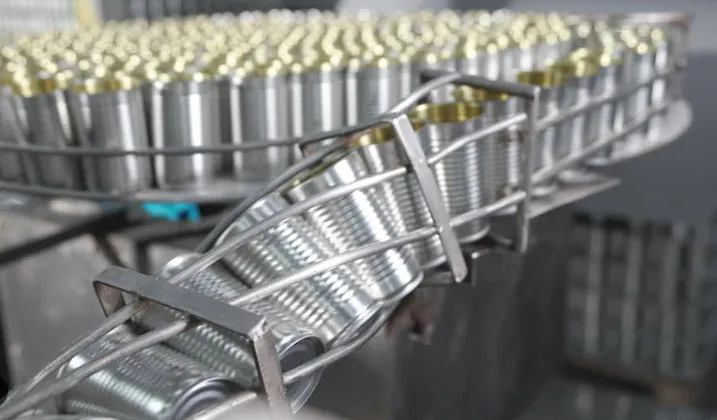
In today’s competitive food industry, efficiency is not just a goal—it’s a necessity. For canned food producers, a highly efficient production line is the backbone of profitability, product quality, and market responsiveness. This article explores the inner workings of these lines and the key technologies that drive their seamless, high-speed operation.
1. Understanding the Canned Food Production Line
At its core, a canned food production line is a fully integrated system designed to transform raw food ingredients into safely sealed, shelf-stable canned products with minimal human intervention. The entire process is a continuous flow, where each stage is precisely synchronized with the next. This orchestration from raw material to palletized goods ensures that speed and hygiene are maintained, maximizing output while minimizing costs and the risk of contamination.
2. What Defines a Canned Food Production Line?
A modern canned food line is defined by its key processing stages, which are seamlessly linked. The major stages include:
- Preparation: Raw vegetables, fruits, or meats are washed, sorted, peeled, cored, and cut by automated equipment.
- Blanching (for vegetables): Food is briefly heated in water or steam to deactivate natural enzymes that could cause spoilage.
- Filling: Precise filling machines deposit the food product into cans, ensuring consistent weight and portion control.
- Liquid Addition (Brining/Saucing): A separate station adds sauces, syrups, or brines, leaving precisely the correct headspace.
- Exhausting: Air is removed from the filled can to create a vacuum upon sealing, which is crucial for preserving quality and preventing spoilage.
- Seaming/Closing: The can is hermetically sealed with a lid using a double-seaming process, creating an airtight barrier.
- Thermal Processing (Retorting): The sealed cans are heated to a specific temperature for a set time in a pressure cooker called a retort to destroy all harmful microorganisms.
- Cooling & Labeling: Cans are rapidly cooled to stop the cooking process, then dried and labeled by high-speed automated labelers.
- Packing & Palletizing: Finally, cans are packed into cases and stacked onto pallets for storage and shipment.
3. Key Features Driving Efficiency in Modern Lines
Efficiency is engineered into modern canning lines through several critical features:
- High-Speed Filling & Seaming: The heart of the line. Modern rotary fillers and seamers can process thousands of cans per hour with extreme accuracy, minimizing product giveaway and ensuring perfect seals every time.
- Intelligent Process Control (IPC): PLCs (Programmable Logic Controllers) and SCADA (Supervisory Control and Data Acquisition) systems monitor and control every parameter—from temperatures and pressures to fill weights and line speed—allowing for real-time optimization and rapid problem identification.
- Integrated Thermal Processing (Retorting): Advanced retorts use precise control over temperature and pressure, often with water or steam-air mixtures, to reduce process times while ensuring safety. Automated loading/unloading systems (AGVs/Robots) keep the retorts running at maximum capacity.
- Automated Quality Checks: Vision inspection systems, checkweighers, and metal detectors are integrated throughout the line to automatically reject any non-conforming products, ensuring only perfect cans proceed downstream.
- Modular & Scalable Design: Lines are often built with modular components, allowing manufacturers to easily upgrade specific sections (e.g., a faster filler) or expand capacity without replacing the entire system.
4. Why Efficiency Matters in Food Canning
The drive for efficiency is not just about speed; it has direct and profound impacts on the business:
- Cost Reduction: Higher throughput and reduced downtime lower the cost per can. Accurate filling reduces product giveaway, and automated systems cut labor costs.
- Product Quality & Safety: Consistent, automated processes eliminate human error, leading to uniform product quality. Precise thermal processing guarantees food safety while better preserving the product’s texture, color, and nutrients.
- Enhanced Flexibility & Sustainability: Efficient lines can be quickly reconfigured for different can sizes or products, allowing manufacturers to respond swiftly to market trends. Furthermore, efficient use of energy, water, and raw materials significantly reduces the environmental footprint of the operation.
5. The Role of Advanced Technologies
Beyond the core machinery, several technologies are becoming integral to peak efficiency:
- Industrial Internet of Things (IIoT): Sensors collect vast amounts of data from motors, bearings, and processes. This data is analyzed to predict maintenance needs (predictive maintenance) before a breakdown occurs, preventing costly unplanned stoppages.
- AI-Powered Optimization: Artificial intelligence algorithms can analyze production data to find the optimal line speed settings that balance throughput with energy consumption, further driving down operational costs.
- Robotic Palletizing: Robots provide fast, reliable, and flexible case-packing and palletizing, adapting to different package patterns without the need for mechanical changeovers.
An efficient canned food production line is a sophisticated symphony of mechanical engineering, process control, and smart technology. By integrating high-speed automation with intelligent data management, modern producers can achieve unparalleled levels of productivity, quality, and profitability. Investing in these advanced systems is no longer a luxury but a fundamental requirement for staying competitive in the global food market.