
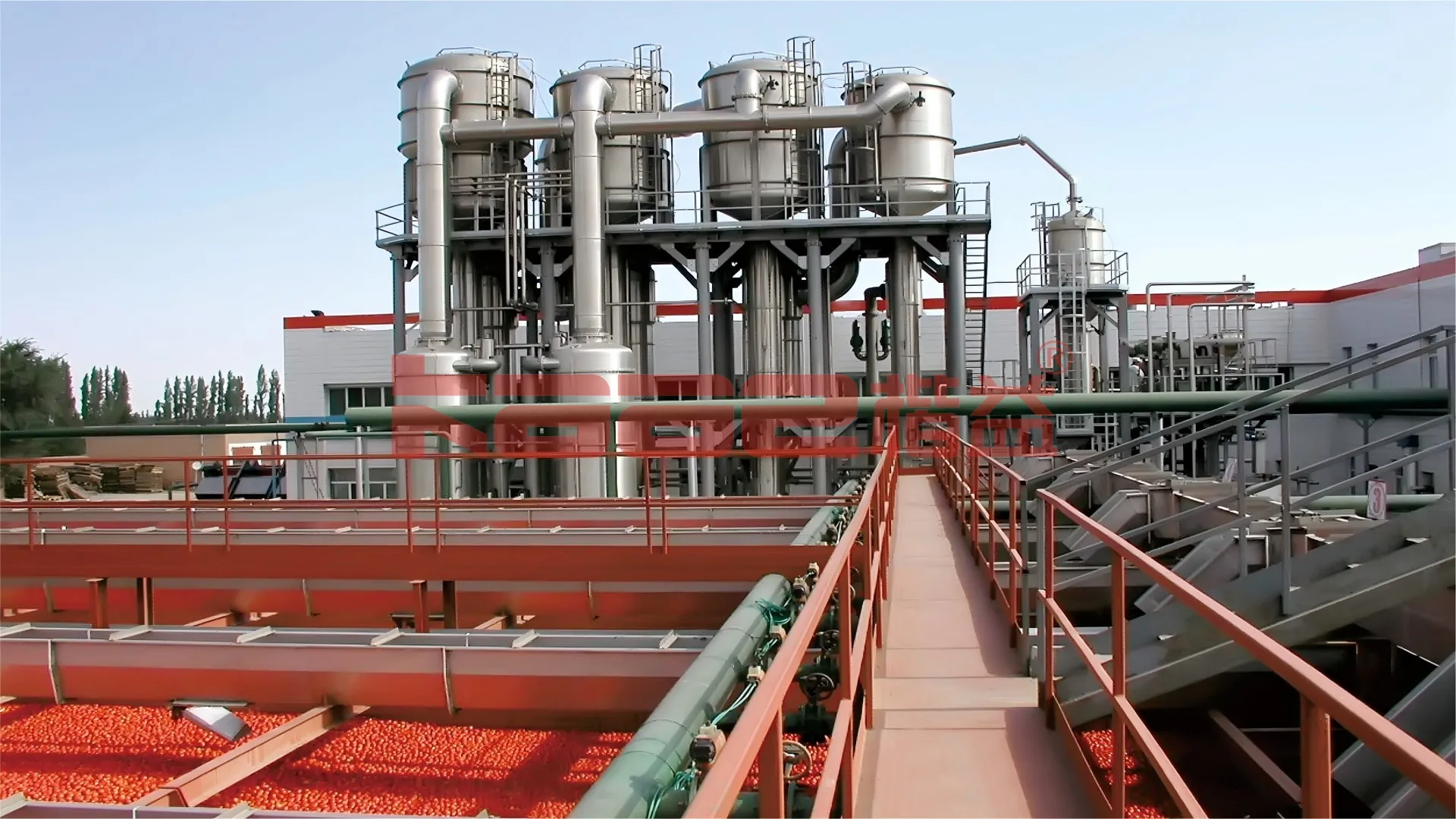
Tomato paste is one of the most widely used tomato-based products in the global food industry, serving as a key ingredient for sauces, ketchups, canned foods, and ready-to-eat meals. While it appears simple, producing high-quality tomato paste requires a carefully designed manufacturing process and precise equipment configuration.
At KAAE, we specialize in providing integrated tomato processing solutions. Below is a comprehensive overview of the industrial tomato paste manufacturing process, explaining each stage from raw material selection to final packaging.
Overview of the Tomato Paste Manufacturing Process
A standard industrial tomato paste production line follows this sequence:
Fresh Tomatoes → Washing → Crushing → Preheating & Enzyme Inactivation → Pulping → Blending → Vacuum Concentration → Sterilization → Filling → Secondary Sterilization (if required)
The final process flow and equipment selection may vary depending on:
- Target Brix level
- Tomato variety
- End-product specifications
- Packaging format
1. Raw Tomato Selection
The quality of tomato paste starts with raw material selection.
Key requirements:
- Fully ripened tomatoes with bright red color
- Balanced sugar-to-acid ratio
- No mold, rot, or severe mechanical damage
Different tomato varieties have varying water content, pectin levels, and natural viscosity. These factors directly influence paste thickness, yield, and final Brix level. At KAAE, raw material characteristics are evaluated before process design to ensure stable output quality.
2. Washing
After harvesting, tomatoes often carry soil, pesticide residues, and impurities.
Process characteristics:
- Bubble washing or spray washing systems
- Continuous water circulation and filtration
Key control points:
- Avoid excessive mechanical stress during washing
- Maintain clean and flowing wash water to prevent cross-contamination
Effective washing is essential for food safety and downstream equipment protection.
3. Crushing
Washed tomatoes are crushed into pulp to prepare for thermal treatment.
Technical considerations:
- Uniform particle size for efficient heat transfer
- Controlled crushing intensity to preserve color and flavor
Over-crushing can damage tomato cells excessively, leading to color degradation and flavor loss.
4. Preheating and Enzyme Inactivation
Crushed tomato pulp is rapidly heated to deactivate enzymes.
Typical parameters:
- Temperature: 85–95°C
- Short holding time
Purpose:
- Inactivate polyphenol oxidase (prevents browning)
- Inactivate pectinase (prevents viscosity loss)
This step is critical for maintaining bright color and stable texture in tomato paste.
5. Pulping (Skin and Seed Removal)
Preheated pulp is refined using pulping machines to remove skins, seeds, and coarse fibers.
Process design:
- Single-stage or multi-stage pulping
- Different sieve sizes based on product quality requirements
High-grade tomato paste typically requires multi-stage refining to achieve smooth texture and consistent viscosity.
6. Blending
The refined tomato pulp can be adjusted according to product standards and market requirements.
Possible adjustments:
- Salt addition
- Sugar adjustment
- Acidity control
Blending systems ensure uniform mixing, guaranteeing consistent taste and composition throughout the batch.
7. Vacuum Concentration
Vacuum concentration is the core step in tomato paste production.
Key advantages of vacuum concentration:
- Low-temperature evaporation
- Preservation of color, flavor, and nutrients
- High energy efficiency
Common Brix levels:
- 28–30%
- 30–32%
- 36–38%
The concentration ratio is precisely controlled to meet customer and market specifications.
8. Sterilization
Before packaging, concentrated tomato paste must be sterilized to ensure microbiological safety.
Key considerations:
- Temperature and holding time matched to paste viscosity
- Avoid excessive heat to prevent flavor degradation
Proper sterilization ensures shelf stability without compromising product quality.
9. Filling
Sterilized tomato paste is filled under controlled hygienic conditions.
Common packaging options:
- Aseptic bags (for industrial use)
- Tin cans
- Glass bottles
Filling systems are selected based on output capacity, packaging type, and market requirements.
10. Secondary Sterilization (Optional)
Secondary sterilization is applied depending on the packaging format.
Typically required for:
- Glass bottles
- Metal cans
Key control point:
- Precise sterilization intensity to avoid can swelling or container deformation
KAAE’s Engineering Approach
At KAAE, we design tomato paste processing lines based on:
- Raw tomato characteristics
- Target product positioning
- Required Brix range
- Factory layout and automation level
Our goal is not only to produce tomato paste, but to help clients achieve:
- Stable product quality
- High yield and low loss
- Energy-efficient operation
- Long-term production reliability